
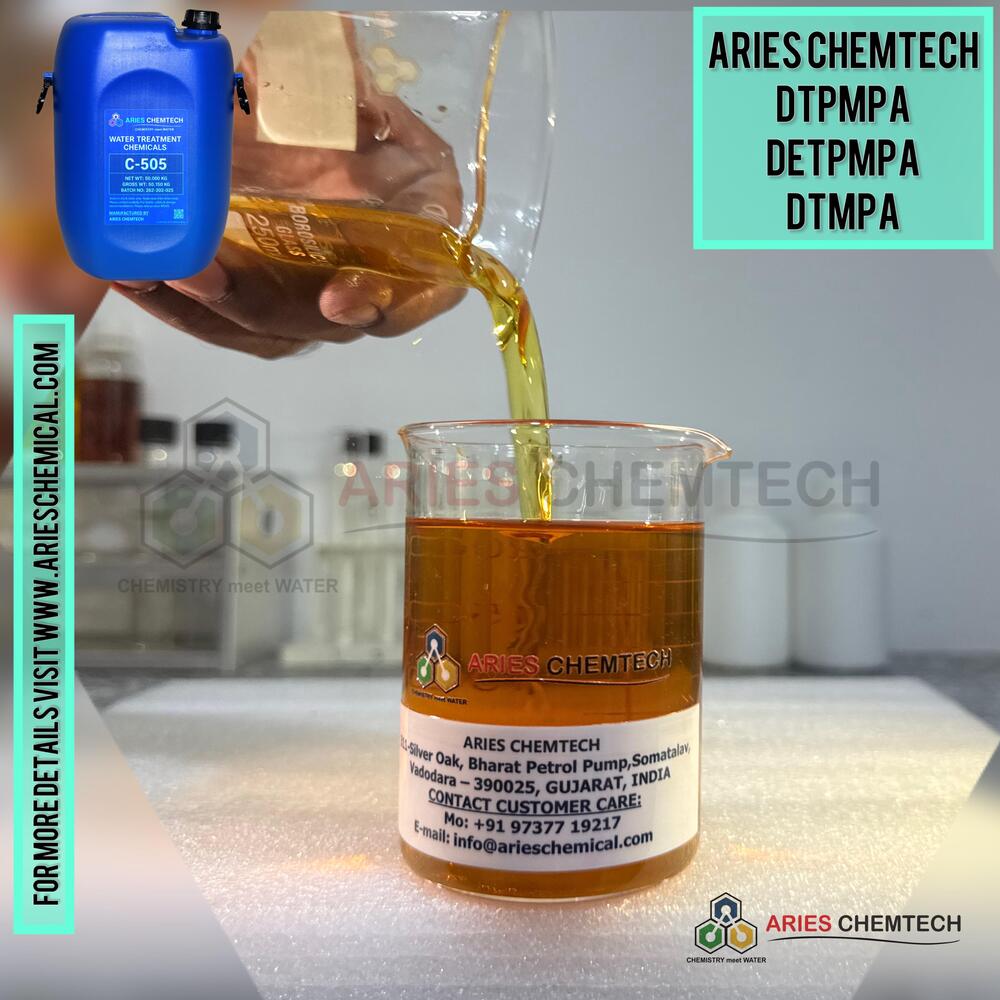
| Chemical Name | Diethylenetriamine Penta Methylene Phosphonic Acid |
| Grade | Reagent Grade |
| Active Content / Purity | 50% |
| Appearance | Clear, amber to brownish-red aqueous solution |
| Usage | Industrial |
| Solubility | In Water |
| Physical Form | Liquid |
| Minimum Order Quantity | 100 Kilograms |
| Supply Ability | 10,000 Kilograms Per Month |
| Delivery Time | Next Days |
| Main Domestic Market | All India |
Diethylenetriamine Penta Methylene Phosphonic Acid is a high-purity reagent-grade liquid chemical extensively utilized in industrial applications. Offering 50% purity, this water-soluble compound is designed to meet rigorous industrial standards, ensuring optimal results in specialized applications. Its liquid form enhances ease of use, blending seamlessly in aqueous solutions for maximum efficiency. Known for its superior performance, the product is employed across various industries requiring reliable chemical formulations. Whether its water treatment, scale prevention, or other industrial processes, Diethylenetriamine Penta Methylene Phosphonic Acid delivers consistent outcomes tailored for professional-grade tasks.
DTPMPA, or Diethylenetriamine Penta Methylene Phosphonic Acid, is an organophosphonic acid used across industrial water treatment as a scale inhibitor and metal-ion chelating agent. It carries five phosphonate groups on a diethylenetriamine backbone, which gives it a stronger grip on dissolved calcium, magnesium and iron than phosphonates built with fewer active groups. Aries Chemical manufactures and supplies DTPMPA from its Vadodara, Gujarat facility for boiler, cooling tower, RO pretreatment, oilfield and paper & pulp water treatment programs across India.
DTPMPA — also written DTPMP — stands for Diethylenetriamine Penta Methylene Phosphonic Acid. It belongs to the organophosphonic acid family: compounds built around a phosphonate group, where phosphorus bonds directly to carbon, rather than the phosphate esters used in older water treatment chemistries. That carbon-phosphorus bond is why phosphonates hold up in hot, alkaline or hard water where phosphate-based inhibitors break down.
What sets DTPMPA apart within its own family is the number of phosphonate groups on the molecule. ATMP carries three and HEDP carries two; DTPMPA carries five, attached to a diethylenetriamine backbone with three nitrogen atoms. More phosphonate groups means more sites for a calcium, magnesium or iron ion to bind to, which is why DTPMPA is generally the strongest metal chelator in the phosphonate range and why it gets specified for harder, more mineral-heavy water than ATMP or HEDP are typically asked to handle.
At industrial dosing levels the molecule works two ways: at very low, sub-stoichiometric concentrations it interferes with crystal formation before scale can deposit threshold inhibition and at higher concentrations it actively sequesters metal ions in solution, keeping them from precipitating at all.
DTPMPA controls scale through a combination of mechanisms rather than one single action.
Metal-Ion Chelation
Each DTPMPA molecule carries five phosphonate groups arranged around a diethylenetriamine backbone. Those groups form stable complexes with dissolved calcium, magnesium and iron, locking the metal ion in solution so it can’t go on to react with carbonate, sulfate or hydroxide ions and form scale. This is what makes DTPMPA a chelating agent rather than just an inhibitor — at stoichiometric concentrations it’s binding the metal directly, not just interfering with crystal growth around it.
Threshold Scale Inhibition
At the sub-stoichiometric doses actually used in industrial systems a small fraction of what full chelation would require DTPMPA works differently. It adsorbs onto the surface of forming crystal nuclei and distorts their growth before they’re large enough to become adherent scale. This threshold effect is why phosphonates get dosed in single-digit to low double-digit ppm ranges rather than matched stoichiometrically to hardness, and it’s a big part of DTPMPA’s cost-effectiveness in high-hardness water.
Crystal Growth Control
Phosphonate groups also disrupt the regular lattice structure that calcium carbonate and calcium sulfate crystals need to grow into hard, adherent deposits. Where scale does form in a DTPMPA-treated system, it tends to stay soft and dispersed rather than bonding to metal surfaces which matters more in practice than preventing crystal formation outright, since some is unavoidable in concentrated, high-cycle systems.
Deposit and Particle Dispersion
DTPMPA also has a deflocculating effect it helps keep fine solid particles, including any scale crystals that do form, suspended in the water rather than settling and consolidating on equipment surfaces. Combined with its stability under heat and hydrolysis, this dispersing action is part of why Aries positions DTPMPA for systems handling elevated iron alongside hardness, where deposit control matters as much as scale prevention itself.
Industrial water always carries dissolved minerals, and the moment that water gets heated, concentrated by evaporation, or pushed through a membrane, those minerals start looking for somewhere to precipitate. DTPMPA is used because it addresses several of these problems from a single dosing point instead of needing separate chemistries for each one: it prevents calcium and magnesium scale on heat-transfer surfaces, it keeps iron in solution instead of letting it deposit as rust-coloured fouling, it stays active across a wide pH range from acidic to alkaline, and it holds up under heat and prolonged residence time better than many alternatives.
Because it’s doing metal-ion control alongside scale inhibition, DTPMPA is usually specified as part of a broader treatment program with a corrosion inhibitor and a biocide, rather than asked to handle corrosion on its own. It supports a corrosion-control program indirectly by keeping metal surfaces free of the scale deposits that create differential-aeration corrosion cells, but it isn’t formulated as a standalone corrosion inhibitor.
In hard water, calcium carbonate is usually the scale you see first the white, chalky buildup inside pipes and heat exchangers. Where sulfate levels are also high, calcium sulfate becomes a second scale-forming path, and a harder one to manage, because calcium sulfate gets less soluble at higher temperatures, which is exactly when boilers and cooling systems are running hardest.
Both show up first in heat-transfer equipment, because that’s where water concentrates and surface temperature runs highest a boiler tube or a cooling tower heat exchanger sees local conditions well past what the bulk water temperature suggests. Once a thin scale layer forms, it acts as an insulator: heat transfer drops, fuel or energy use climbs to compensate, and the equipment runs hotter than it’s rated for.
DTPMPA works here as a threshold inhibitor: dosed well below stoichiometric levels, it interferes with calcium carbonate and calcium sulfate crystal formation early enough that the minerals stay soluble and pass through the system instead of depositing on it.
DTPMPA shows up across several industrial water systems, and the specific role it plays shifts depending on what’s driving the scaling or fouling problem in that application.
Cooling towers concentrate whatever hardness is in the makeup water every time they cycle — a tower running at five cycles of concentration carries roughly five times the calcium and magnesium of the water going in. That concentration effect, combined with the warm, oxygenated, sunlit environment inside a cooling tower, makes scale formation on condenser tubes and fill media a constant pressure. DTPMPA is used in cooling tower programs for its scale-inhibiting and metal-chelating action, usually alongside a dispersant and a biocide as part of the full treatment program rather than on its own. [Dosage and cycles-of-concentration limits should be set against actual makeup water analysis, not stated generically here.]
Boilers push the scaling problem further because of the temperatures involved. Calcium and magnesium salts that stay soluble at ambient temperature come out of solution readily once water is heated past boiling point, and any scale that forms on a boiler tube wall cuts heat transfer at exactly the point where the metal is already under the most thermal stress. DTPMPA’s role in a boiler water program is to keep hardness salts in solution through internal treatment, working alongside oxygen scavengers and pH-control chemicals that handle the rest of the boiler chemistry.
RO Water Treatment / Membrane Pretreatment
DTPMPA is used in some RO pretreatment and antiscalant formulations for scale control ahead of the membrane, but it isn’t a universal fit for every RO system. Whether DTPMPA, or a DTPMPA-based blend, is the right choice depends on feed water chemistry particularly hardness, silica and iron the membrane manufacturer’s chemical compatibility limits, and the recovery rate the system runs at. Any RO application should be confirmed against the feed water analysis and the membrane element’s technical data sheet rather than assumed.
Oilfield Water Treatment
In oilfield water injection systems, DTPMPA is used for scale control where produced or injection water carries high mineral content the same chelating and threshold-inhibition action that works in boilers and cooling towers applies to preventing mineral scale in injection lines and downhole equipment. [Specific oilfield dosing and compatibility with other oilfield chemicals should be confirmed by the technical team against the operator’s water analysis.]
Paper & Pulp Industry
Paper and pulp process water carries its own scaling load from process chemistry and recycled water streams. Aries’ phosphonate range, including DTPMPA, is positioned for this sector’s scale-control and metal-ion management needs, protecting process equipment from the deposits that reduce throughput and force unplanned cleaning shutdowns.
Hard water gets its name from dissolved calcium and magnesium, usually alongside some iron, and the harder the water, the faster and more aggressively it scales equipment. This is DTPMPA’s strongest use case within the phosphonate range: because it carries five phosphonate groups instead of two or three, it has more binding capacity per molecule for calcium, magnesium and iron than ATMP, HEDP or PBTC. That’s not automatically an advantage in every application for lower-hardness water where a simpler, less expensive phosphonate does the job, DTPMPA’s extra chelation capacity may be more than the system needs. But in genuinely hard water, or where iron is a recurring fouling problem alongside hardness, DTPMPA’s structure gives it more to work with. Water chemistry ultimately decides which phosphonate, or blend, is the right fit confirm against an actual water analysis rather than defaulting to the strongest chelator by habit.
Product | General Characteristic | Typical Application Focus |
ATMP | Scale and corrosion inhibition at low dose | Boilers, cooling systems, oilfield |
HEDP | Scale inhibition, strong high-temperature stability | Boilers, cooling systems, textile processing |
PBTC | Scale control with strong iron dispersion | Cooling towers, desalination pretreatment |
DTPMPA | Strongest metal-ion chelation in the range five phosphonate groups | Hard water, boilers, cooling, oilfield, paper & pulp |
PAPEMPA | Polymer phosphonate scale control plus dispersancy | Cooling towers, membrane systems |
ATMP carries three phosphonate groups against DTPMPA’s five, and it’s the more commonly used general-purpose phosphonate across Aries’ range it does scale and corrosion inhibition well at low dose across boilers, cooling circuits and oilfield injection water. DTPMPA earns its place over ATMP specifically where hardness or iron content is high enough that ATMP’s chelation capacity isn’t enough to keep up. For moderate-hardness water where ATMP already performs, moving to DTPMPA usually isn’t necessary.
HEDP is built around two phosphonate groups and is known mainly for holding up at high temperature. DTPMPA doesn’t really compete with HEDP on thermal stability so much as on chelation capacity: where HEDP is doing threshold inhibition well but the water also carries significant dissolved iron or unusually high hardness, DTPMPA’s five-phosphonate structure gives it more to work with on the metal-ion side.
PBTC’s strength is iron dispersion and hydrolytic stability, which is why it gets positioned for cooling towers and desalination pretreatment where suspended iron and fouling are the main concern rather than hardness alone. DTPMPA and PBTC aren’t always substitutes for each other PBTC is chosen when the fouling problem is mainly about keeping iron and suspended solids from settling out, while DTPMPA is chosen when the dominant problem is calcium, magnesium and iron chelation in genuinely hard water. Some treatment programs use both together.
DTPMPA is generally compatible with the other chemistries used in an integrated water treatment program polymers, dispersants, biocides and other phosphonates are routinely dosed alongside it. But compatibility in water treatment is never a blanket yes: it depends on the concentration of each chemical, system pH, temperature, the water’s own chemistry, and the specific formulation being used. Confirm compatibility for your treatment program with Aries’ technical team before combining DTPMPA with another additive at scale, particularly where oxidizing biocides are involved.
We’re not going to give you a number here, and if anyone else does without seeing your water analysis, be skeptical of it. DTPMPA dosage depends on water hardness, calcium and magnesium concentration, iron content, alkalinity, pH, operating temperature, cycles of concentration, system volume and flow rate, RO recovery rate where applicable, whether scale is already present, and what other treatment chemicals are already in the program. Any one of these can shift the right dose meaningfully. For application-specific dosage recommendations, contact Aries Chemical with your water analysis and operating conditions.
Get any one of these wrong dose too low for the actual hardness, or run a system past the pH range the product is designed for and inhibition performance drops off fast rather than gradually. Dosage needs to be set against real water data, not a standard figure.
Aries Chemical supplies DTPMPA from its Vadodara, Gujarat manufacturing facility with pan-India dispatch. Aries has export capability across its wider phosphonate range and can support documentation for overseas shipments on request.
Aries Chemical manufactures and supplies DTPMPA from Vadodara, Gujarat, as part of a phosphonate range that also includes ATMP, HEDP, PBTC and PAPEMPA. The company operates under ISO 9001:2015 certification and supplies pan-India, with technical support available for selecting the right phosphonate or blend for a given water chemistry rather than defaulting to one product across every application. Buyers searching for a DTPMPA manufacturer in India, a DTPMPA supplier in Gujarat, or a DTPMPA chemical supplier for a specific application can reach Aries’ technical team directly for product data and pricing.
The product is available in Clear, amber to brownish-red aqueous solution, ensuring easy handling and application.
Diethylenetriamine Penta Methylene Phosphonic Acid offers an exceptional purity level of 50%.
Yes, it is fully soluble in water, making it highly versatile for industrial applications.
It is categorized as reagent grade, ensuring high standards for industrial use.
Diethylenetriamine Penta Methylene Phosphonic Acid is mainly used in various industrial processes, including water treatment and scale prevention.
DTPMPA is short for Diethylenetriamine Penta Methylene Phosphonic Acid, an organophosphonic acid used as a scale inhibitor and metal-ion chelating agent in industrial water treatment. It’s part of the same phosphonate family as ATMP, HEDP and PBTC, but with five phosphonate groups instead of two or three.
It’s used to prevent calcium, magnesium and iron scale from forming in boilers, cooling towers, RO pretreatment, oilfield water injection and paper & pulp process water, through metal-ion chelation and threshold scale inhibition rather than by removing scale that’s already formed.
Yes. At the low, sub-stoichiometric doses used in industrial systems, DTPMPA interferes with crystal formation early enough to keep calcium and magnesium salts in solution instead of precipitating as scale.
Through two mechanisms working together: chelation, where the molecule’s phosphonate groups bind directly to metal ions in solution, and threshold inhibition, where it disrupts crystal growth at doses far below what full chelation would require.
Yes, DTPMPA is water-soluble, which is standard for phosphonates used in liquid dosing systems.
Cooling towers, boilers, RO and membrane pretreatment programs, oilfield water injection systems, and paper & pulp process water, depending on the specific water chemistry and fouling problem involved.
Yes. It’s used for scale and metal-ion control in recirculating cooling water, typically as part of a program that also includes a dispersant and a biocide.
Yes, as part of an internal treatment program alongside oxygen scavengers and pH-control chemicals. DTPMPA’s role is scale and metal-ion control specifically, not the full boiler water chemistry.
It can be used in some RO pretreatment and antiscalant formulations, but suitability depends on feed water chemistry, membrane compatibility and recovery rate. Confirm against your membrane manufacturer’s chemical compatibility data before use.
Water hardness, calcium and magnesium levels, iron content, alkalinity, pH, temperature, cycles of concentration, system volume and flow rate, and whatever other treatment chemicals are already in use. There’s no standard dose it’s set against your actual water analysis.
Contact Aries with your required quantity, application and water analysis where available, and the technical team will recommend the right grade and dosing approach.
Looking for a DTPMPA supplier in India for boiler, cooling tower, RO or oilfield water treatment? Aries Chemical manufactures DTPMPA from its Vadodara, Gujarat facility with pan-India dispatch. Share your water analysis and application details and the technical team will recommend the right grade and dosing approach.
Get high-performance, cost-effective Consumable Chemicals backed by expert technical support and on-time delivery.
Aries Chemicals is an ISO 9001:2015 certified water treatment and specialty chemicals company, delivering reliable and performance-driven chemical solutions to a wide range of industries.