

| Minimum Order Quantity | 100 KGS |
|---|---|
| Supply Ability | 1000 Kilograms Per day |
| Delivery Time | Days |
| Main Domestic Market | All India |
| Parameter | Information |
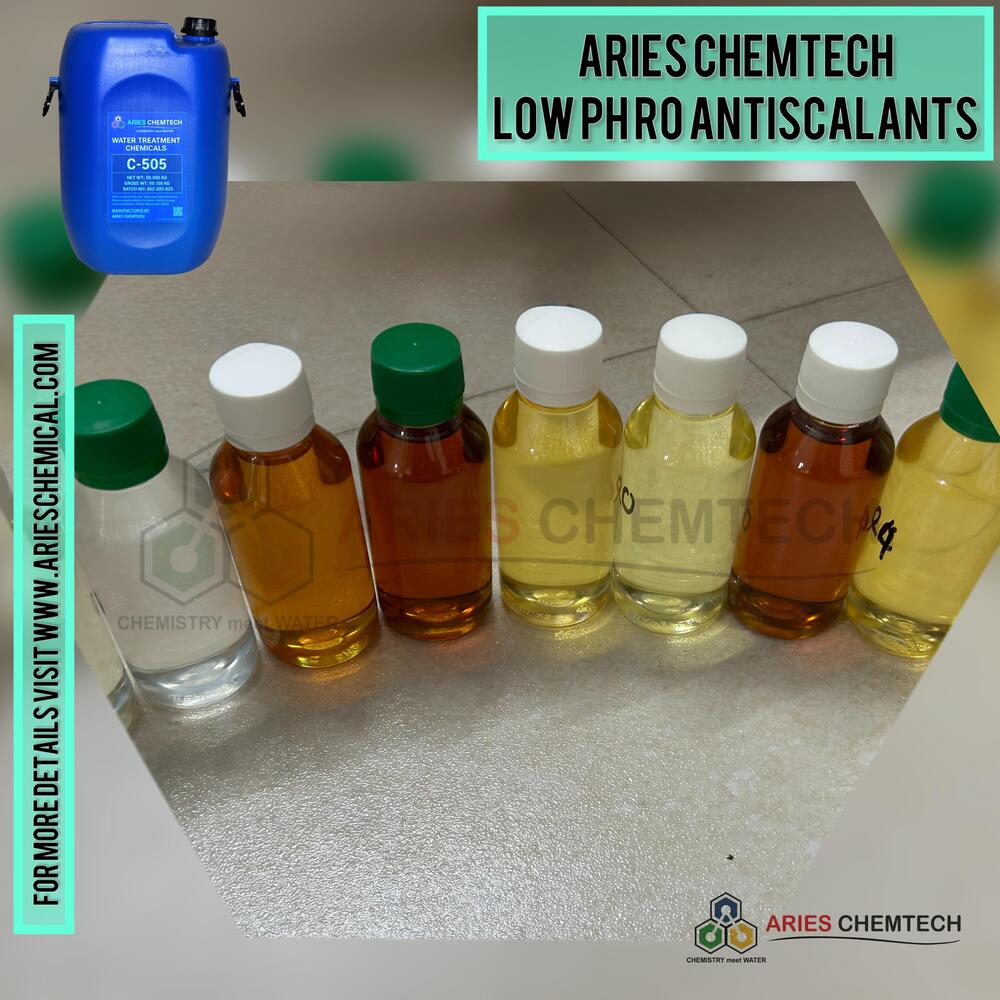
| Product name | Low pH RO Antiscalant |
| Chemical name | Antiscalant |
| Physical form | Liquid |
| Grade | Industrial Grade |
| Solubility | Soluble in water |
| Active content | 100% |
| Operating pH range | 6.0 to 8.5 |
| Recommended dose | Set from feed water analysis. |
| Application | Industrial and commercial RO plants |
| Shelf life | 12 months |
| Storage | Keep container tightly closed in a cool, well-ventilated area |
| Packaging | 50 KGS CARBOYS / 200 KGS DRUM /1000 KGS IBC |
| Minimum order quantity | 100 KGS |
| Supply ability | 1000 Kilograms Per day |
| Price | From INR 70 per kg |
| Market | All India |
| Purity | 100% |
Low pH RO Antiscalant is an industrial-grade solution designed to efficiently prevent scale formation in reverse osmosis (RO) systems. It boasts a remarkable purity of over 99%, ensuring optimal performance in demanding applications. This liquid antiscalant exhibits excellent solubility in water, making it easy to integrate into existing systems for seamless operation. Formulated with technical-grade precision, it is ideal for controlling mineral scaling while maintaining system efficiency and longevity. For best results, it should be stored at room temperature to preserve its effectiveness. This product is a reliable and valuable choice for industries seeking to enhance the durability and performance of their RO systems.
Low pH RO antiscalant is a liquid scale inhibitor for reverse osmosis systems that run at lower feed pH, or where acid dosing is already part of the daily routine. Aries Chemical manufactures it in Vadodara, Gujarat, and supplies it to industrial and commercial RO plants across India. If you are still comparing grades, our RO antiscalant chemicals page covers the full range. This page is about the low pH grade only.
An antiscalant is dosed into RO feed water in very small amounts so that dissolved salts stay in solution while the water gets more concentrated inside the membrane elements. Without it, calcium carbonate and calcium sulphate begin to crystallise on the membrane surface. Permeate flow drops, pressure climbs, and cleaning cycles get shorter.
The low pH grade is made for plants where the feed is acidified, or where the pH sits on the lower side for other reasons. Plenty of plants dose acid to keep carbonate scale in check. Acid helps with carbonate, but it does very little for sulphate scale, and it adds its own chores: another chemical to store, another pump to maintain, another hazard on site. Some plants cannot pre-acidify at all. This antiscalant is formulated for those conditions, so scale control does not rest on acid alone.
Antiscalants of this type are built on polymer and phosphonate chemistry, and they work in three ways at once. The first is threshold inhibition: at a low dose, the molecules stop scale-forming ions from grouping into crystals, so the water can be pushed past the point where it would normally scale. The second is crystal modification: any crystals that do form come out distorted and weak, and they struggle to lock onto the membrane. The third is dispersion: fine particles stay suspended and leave with the concentrate instead of settling.
The exact blend is proprietary. If your team wants to know more about the chemistry behind it, ask our technical team. We also supply the polymers and phosphonates used in these blends, listed under raw materials for RO antiscalants, and a wider range of scale inhibitors for other systems.
This grade is used against calcium carbonate and calcium sulphate scaling, particularly in high TDS feed water. It is not the answer to every water problem. If your feed carries a lot of silica, a high silica RO antiscalant is the better fit. If the membrane is already fouled, an antiscalant will not clean it. That is a job for the RO membrane cleaner.
Our low pH RO antiscalant works in the pH range of 6.0 to 8.5. Inside that window, what decides performance is the rest of the water analysis: TDS, hardness, alkalinity, sulphate, silica, temperature and the recovery your system runs at.
Recovery matters more than most people expect. At 75% recovery, the concentrate leaving the last stage is roughly four times as concentrated as the feed. At 50% recovery it is about double. The same water that is easy at 50% can scale a membrane at 75%. Check your membrane supplier’s guidelines for compatibility with any antiscalant before switching products.
There is no single dose that suits every plant. The right figure comes from your feed water analysis, and two plants a few kilometres apart can run the same product at quite different rates. We look at TDS, hardness, alkalinity, sulphate, silica, pH, temperature, RO recovery and membrane type. Aries also uses a computational dosing tool that works from the water report to arrive at a dose.
As a rough reference, our RO selection guide lists about 3 to 5 mg/L for high hardness, calcium scaling water. Treat that as a starting point for a conversation, not a setting to copy onto your dosing pump.
For feeding, antiscalant is normally dosed continuously with a metering pump into the feed line ahead of the cartridge filter, with enough pipe length or a mixer for it to blend before it reaches the membranes. Check pump output against tank level every shift. An empty tank or a stalled pump is easy to miss and hard to undo once scale has formed.
Point | Low pH RO antiscalant | Standard RO antiscalant |
Made for | Lower pH feed, or plants that dose acid | General RO feed water |
Acid dosing | Works alongside it, or where it is not practical | Depends on the grade |
Scale control | Carbonate and sulphate scale | Depends on the formulation |
How to choose | Feed water analysis | Feed water analysis |
Neither one is better in every case. The choice follows your water analysis, not the label.
Industrial RO plants in textile, pharmaceutical and chemical manufacturing units use it, as do commercial systems in hotels, hospitals and food processing. It is also used in effluent treatment and ZLD plants where RO handles concentrated streams.
The antiscalant is one part of a set. Most RO plants also need a non-oxidizing biocide for biological control and SMBS (sodium metabisulphite) to remove residual chlorine before the membrane. The full set is on our RO plant chemicals page. If the same site runs cooling towers, see our cooling tower antiscalant.
Keep the container tightly closed in a cool, well-ventilated area and use it within its shelf life. Ask for the safety data sheet before first use. As an RO antiscalant supplier in Gujarat and across India, we ship from Vadodara in quantities from a 2 kg trial pack up to 1,000 kg a month.
Share your feed water analysis with our technical team. We will recommend a suitable antiscalant and a starting dose for your operating conditions. Water analysis is free for new enquiries. Call +91 97377 19217 or send us your water report and requirement.
Low pH RO Antiscalant is primarily used to prevent scale formation in reverse osmosis systems in industrial settings.
The product is available in liquid form for easy application.
Yes, the product has excellent water solubility, making it suitable for RO system integration.
It should be stored at room temperature to maintain its performance and effectiveness.
The product boasts a purity level of over 99%, ensuring robust and reliable results.
It is a liquid scale inhibitor for RO systems that run at lower feed pH or use acid pre-treatment. It keeps calcium carbonate and calcium sulphate in solution so they do not form scale on the membrane.
A low pH grade is formulated for lower pH operation and for plants that dose acid, or cannot. A standard grade is aimed at general RO feed water. Which one you need depends on your water analysis.
Our reference range is pH 6.0 to 8.5 . Send your feed water report if your pH falls outside it.
It depends on TDS, hardness, alkalinity, sulphate, silica, temperature and recovery. Our selection guide gives about 3 to 5 mg/L as a rough reference for high hardness water. We can calculate a proper dose from your water report.
Calcium carbonate and calcium sulphate. For silica heavy water, use a high silica grade instead.
Yes. It is supplied to industrial RO plants in textile, pharma and chemical manufacturing, and to commercial systems.
In a tightly closed container, in a cool, well-ventilated area. Request the safety data sheet from us before first use.
The minimum order is 100 kg and the price starts at INR 70 per kg. Final pricing depends on quantity and packing.
Yes. Send the report through our contact page. Analysis and dosage recommendation are free for new inquiries.
Get high-performance, cost-effective Consumable Chemicals backed by expert technical support and on-time delivery.
Aries Chemicals is an ISO 9001:2015 certified water treatment and specialty chemicals company, delivering reliable and performance-driven chemical solutions to a wide range of industries.